
Introduction
Artificial intelligence is no longer just a helpful assistant. In 2026, AI productivity tools are quietly replacing entire workflows that once required teams of people, long meetings, and hours of manual work.
From writing content and managing projects to handling customer support and analyzing data, AI is changing how businesses operate every day. Companies are now using smart automation to complete tasks faster, reduce errors, and improve productivity without increasing costs.
What makes this shift different is that many of these tools work silently in the background. They do not just save a few minutes here and there. They replace complete systems that businesses relied on for years.
For freelancers, startups, remote teams, and large companies, understanding these AI tools is becoming essential. Those who adapt early can work smarter and stay competitive in a rapidly changing digital world.
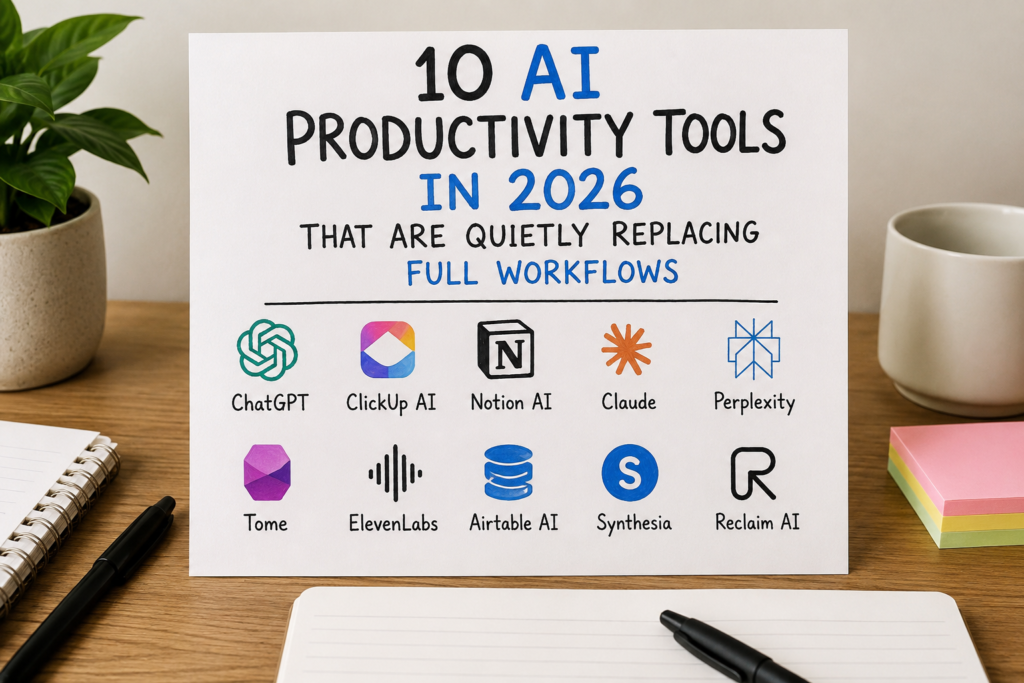
In this article, you will discover 10 powerful AI productivity tools in 2026 that are transforming modern workflows and changing the future of work.
Why AI Productivity Tools Are Growing So Fast
AI adoption is increasing because businesses want three things:
- Faster results
- Lower operating costs
- Better efficiency
Traditional workflows often involve repetitive tasks like:
- Writing reports
- Scheduling meetings
- Sorting emails
- Customer support
- Data entry
- Research
- Social media management
AI tools now handle many of these tasks automatically.
Instead of hiring multiple people for repetitive operations, businesses are using intelligent systems that can work 24/7 with minimal supervision.
This does not mean humans are becoming unnecessary. Instead, AI is removing repetitive work so people can focus on creativity, strategy, and decision-making.
1. AI Writing Assistants That Replace Content Production Pipelines
Content creation used to require:
- Writers
- Editors
- SEO specialists
- Proofreaders
- Content planners
Modern AI writing platforms can now combine these workflows into one streamlined system.
What These Tools Can Do
AI writing assistants in 2026 can:
- Generate blog posts
- Create product descriptions
- Write email campaigns
- Suggest SEO keywords
- Optimize readability
- Repurpose content for social media
Many businesses now use AI to create first drafts in minutes instead of days.
Real-World Example
A small eCommerce business can now produce:
- Weekly blogs
- Product pages
- Email newsletters
- Ad copy
using one AI platform instead of outsourcing to multiple freelancers.
This dramatically lowers content production costs while increasing publishing speed.
2. AI Project Management Platforms Replacing Manual Coordination
Traditional project management often includes endless:
- Meetings
- Status updates
- Spreadsheet tracking
- Team follow-ups
AI-powered project management tools are automating these tasks.
Key Features
Modern AI project managers can:
- Predict project delays
- Assign tasks automatically
- Summarize meetings
- Detect productivity bottlenecks
- Generate progress reports
Some platforms even analyze employee workloads to prevent burnout.
Why Businesses Love It
Managers spend less time chasing updates and more time making important decisions.
Remote teams especially benefit because AI keeps projects organized without constant communication.
3. AI Customer Support Systems Replacing Large Support Teams
Customer service has changed dramatically in recent years.
In 2026, advanced AI chat systems can handle most customer questions without human agents.
What Modern AI Support Tools Can Handle
These systems can:
- Answer FAQs
- Process refunds
- Track orders
- Troubleshoot basic issues
- Translate conversations instantly
- Route complex problems to humans
The Biggest Advantage
AI support tools operate continuously without breaks.
This helps businesses provide:
- Faster responses
- Lower wait times
- 24/7 availability
For small businesses, this creates enterprise-level support without massive staffing costs.
4. AI Meeting Assistants Eliminating Administrative Work
Meetings often create hidden workloads.
Employees spend hours:
- Taking notes
- Writing summaries
- Creating action lists
- Scheduling follow-ups
AI meeting assistants now automate these processes completely.
Features Changing Workflows
Modern meeting AI tools can:
- Record conversations
- Generate transcripts
- Summarize discussions
- Highlight decisions
- Create tasks automatically
Real Productivity Impact
Instead of spending an extra hour organizing meeting notes, teams receive instant summaries immediately after calls end.
This saves companies hundreds of work hours every month.
5. AI Research Tools Replacing Manual Information Gathering
Research used to take days of reading, sorting, and analyzing information.
AI research assistants now process huge amounts of data in minutes.
What AI Research Tools Can Do
These platforms can:
- Summarize articles
- Compare reports
- Extract key insights
- Identify trends
- Generate market analysis
Who Benefits Most
AI research tools are especially useful for:
- Marketers
- Journalists
- Students
- Business analysts
- Startup founders
Instead of manually reviewing dozens of sources, users receive organized summaries with actionable insights.
6. AI Design Tools Simplifying Creative Production
Graphic design once required specialized software skills and professional experience.
AI-powered design tools are making creative production easier for everyone.
Tasks AI Design Platforms Handle
These tools can now:
- Create logos
- Generate social media graphics
- Design presentations
- Edit photos
- Produce marketing banners
- Build website layouts
Why This Matters
Small businesses no longer need large design teams for everyday visual content.
A startup founder can create professional branding materials within minutes using AI-assisted design platforms.
This reduces both production time and marketing expenses.
7. AI Coding Assistants Accelerating Software Development
Software developers are now working alongside AI coding assistants daily.
These tools are not replacing programmers entirely, but they are replacing many repetitive coding tasks.
How AI Coding Tools Help
Modern coding assistants can:
- Generate code snippets
- Detect bugs
- Suggest improvements
- Write documentation
- Explain complex code
- Automate testing
Workflow Changes
Developers now spend less time on repetitive technical work and more time solving complex problems.
This increases software development speed while improving code quality.
8. AI Email Management Tools Replacing Inbox Overload
Email remains one of the biggest productivity killers in modern workplaces.
Professionals often spend several hours daily managing inboxes.
AI email tools are changing that.
Features Driving Adoption
AI email systems can:
- Prioritize important messages
- Draft replies automatically
- Organize conversations
- Remove spam intelligently
- Schedule responses
- Summarize long email threads
Real Benefits
Busy professionals can focus on critical communication instead of sorting hundreds of emails manually.
This leads to better focus and reduced mental fatigue.
9. AI Data Analysis Platforms Replacing Manual Reporting
Data analysis once required technical expertise and complicated spreadsheet work.
AI analytics tools are simplifying business intelligence.
What These Tools Can Do
Modern AI analytics systems can:
- Detect patterns automatically
- Generate dashboards
- Predict trends
- Explain data insights
- Create visual reports
- Identify business opportunities
Example
A retail business can now quickly identify:
- Best-selling products
- Customer buying trends
- Seasonal demand patterns
- Marketing performance
without needing a full-time data analyst.
This helps businesses make smarter decisions faster.
10. AI Workflow Automation Tools Connecting Everything Together
Perhaps the most powerful category is AI workflow automation.
These platforms connect multiple tools and automate entire business processes.
What Workflow Automation AI Can Handle
These systems can automatically:
- Transfer data between apps
- Trigger tasks
- Send notifications
- Create reports
- Update databases
- Manage repetitive operations
Why It Is Revolutionary
Instead of employees manually moving information between systems, AI handles the entire workflow behind the scenes.
For example:
When a customer places an order, AI can automatically:
- Update inventory
- Send invoices
- Notify shipping teams
- Create customer emails
- Update sales dashboards
—all without human involvement.
This level of automation saves enormous amounts of time.
The Hidden Risks of AI Workflow Automation
While AI productivity tools offer huge benefits, businesses should still be careful.
Common Challenges
Overdependence on Automation
Relying too heavily on AI may reduce human oversight.
Data Privacy Concerns
Some AI systems process sensitive company information.
Inaccurate Outputs
AI can still make mistakes or generate incorrect information.
Employee Training Gaps
Teams need proper training to use AI tools effectively.
The best approach is combining AI efficiency with human judgment.
How Businesses Can Prepare for the AI Productivity Era
Businesses that succeed in 2026 are not necessarily replacing employees. Instead, they are upgrading workflows.
Smart Adoption Tips
Start Small
Begin with one or two automation tools.
Focus on Repetitive Tasks
Automate processes that consume unnecessary time.
Train Employees
Help teams understand how to work with AI effectively.
Monitor Performance
Regularly review AI-generated outputs for quality control.
Keep Human Creativity
AI works best when combined with human strategy and innovation.
The Future of AI Productivity Tools
The future of work is becoming increasingly automated.
In the next few years, AI tools may evolve from assistants into fully integrated digital coworkers capable of managing complete operations independently.
We are already seeing AI systems that can:
- Handle customer communication
- Build marketing campaigns
- Analyze business performance
- Manage scheduling
- Create content automatically
As AI technology improves, businesses that embrace smart automation early may gain a major competitive advantage.
Conclusion
AI productivity tools in 2026 are doing far more than helping people save time. They are quietly replacing entire workflows across industries.
From content creation and project management to customer support and data analysis, AI is changing how modern businesses operate every day.
The biggest advantage is not just speed. It is the ability to reduce repetitive work, improve efficiency, and allow people to focus on high-value tasks that require creativity and decision-making.
Businesses that learn how to combine human expertise with AI automation will likely lead the future digital economy.
The key is not to fear automation but to use it wisely.
AI is no longer the future of productivity.
It is the present.
FAQ
1. What are AI productivity tools?
AI productivity tools are software platforms that use artificial intelligence to automate tasks like writing, scheduling, customer support, data analysis, and workflow management.
2. Can AI completely replace human workers?
No. AI can automate repetitive tasks, but human creativity, leadership, and critical thinking are still essential in many industries.
3. Are AI workflow tools expensive?
Many AI tools offer affordable pricing plans for freelancers, startups, and small businesses. Some even provide free versions with limited features.
4. Which industries benefit most from AI productivity tools?
Industries like marketing, customer service, software development, eCommerce, education, and finance benefit heavily from AI automation.
5. Is AI automation safe for businesses?
AI can be very safe when businesses use trusted platforms, protect sensitive data, and maintain human oversight over important decisions.